 Free shipping to the contiguous US ·
 Easy 30-day returns
How to Price Items for a Holiday Market or Craft Fair

Quick answer
If you are working out how to price items for a craft fair or a holiday market, start from your real cost, then add booth fees, packaging and card charges so the price still leaves you a profit. Use round, gift-friendly numbers and at least three price levels: a small impulse item, a core gift, and a few higher-priced pieces. Put a clear price on every item before the doors open.
This is different from pricing a garage sale. At a garage sale you are moving used household goods, often at a quarter to a third of the new price. Our garage sale pricing guide covers that. At a holiday market you are usually selling new or handmade work to people who came to buy gifts. Your costs are higher, and underpricing yourself is the usual mistake.
Start from your real cost, not from the stall next door
Add up what one item actually costs you: materials and packaging (bags, tissue and a gift tag if you offer them); your time to make it, at an hourly rate you could live with; a share of yearly overhead, such as tools or studio rent; a share of this show’s costs (booth fee, travel, parking and a helper if you pay one); and the card reader fee. Check your own rate. In-person taps are often in the mid-2% to 3% range, plus a small per-sale charge, and cash sales skip it.
Then set a price that covers all of that and still leaves a profit. Round up, not down. Rounding to $22 is safer than cutting to $19 just to look cheaper.
Here is a worked example, with made-up numbers so you can swap in your own. Say the item costs you $12 all in, your card reader charges about 2.6% plus 15 cents, and you want close to a 40% margin. The price needs to sit a little above $21. Round it to $22. At $22, the card fee is about 72 cents, your $12 cost is covered, and you keep a little over $9. That $9 has to help pay the booth, not only feel like “profit†on paper.
If a neighboring stall is cheaper, do not automatically match them. You do not know their costs or whether they are making money. Price your work so the day is worth doing.
Work out how many sales pay for the booth
Before you pack the car, add up the day’s costs and divide by the profit on a typical item. That is how many sales you need before the show starts paying you.
Using the example above, a $75 booth fee and $9 of profit per item means you need nine sales just to cover the table. Add $25 for gas and parking, and you need about 11. If that number feels impossible for the fair you booked, the fair may be advertising rather than income. Sometimes that is still worth it, but decide on purpose.
A common planning habit is to bring enough stock to sell two or three times your break-even, weighted toward what usually sells.
Use three price tiers, not one average price
Holiday shoppers arrive with a budget already in mind. A stall that only has $45 pieces loses the person who wanted a $12 stocking stuffer. A stall that only has $8 items leaves no room for a “this is the gift†purchase.
Set out three bands, with the exact numbers fitted to what you make:
- Impulse or stocking stuffers, often in the $5 to $15 range.
- Core gifts, often around $20 to $40, which is where most of the day’s money usually comes from.
- A few higher-priced pieces, often $50 and up, that make the middle tier feel easier and occasionally sell.
You do not have to use those exact bands. What matters is that a browser can find something at more than one level, and that the expensive piece is visible, even if you only bring a few. Ready-to-give packaging, such as a simple box, tissue and a tag, can support a slightly higher price than a loose item in a bag. That is usually a better move than inflating prices “because it is Christmas†with no change in the offer.
Offer bundles instead of panic discounts
If the afternoon is slow, a “20% off everything†sign teaches people to wait, and it can wipe out the margin you just calculated. A bundle keeps more of the price while still feeling generous: “3 soaps for $20†instead of $8 each, or a candle and matches as a set. Write the bundle price on the pack.
Whole-dollar prices work well at a cash-and-tap table: $10, $12, $18, $25. At a market, $25 often feels cleaner than $24.99. Pick one style and use it on every item.
Put a price on every item before the first shopper arrives
Unpriced work is the quiet way to lose a sale. Plenty of people will not ask, especially in a crowded aisle, and you cannot answer ten questions while you make change. Label everything the night before, not during setup. Sort items into price groups, set the price once, then label the whole group.
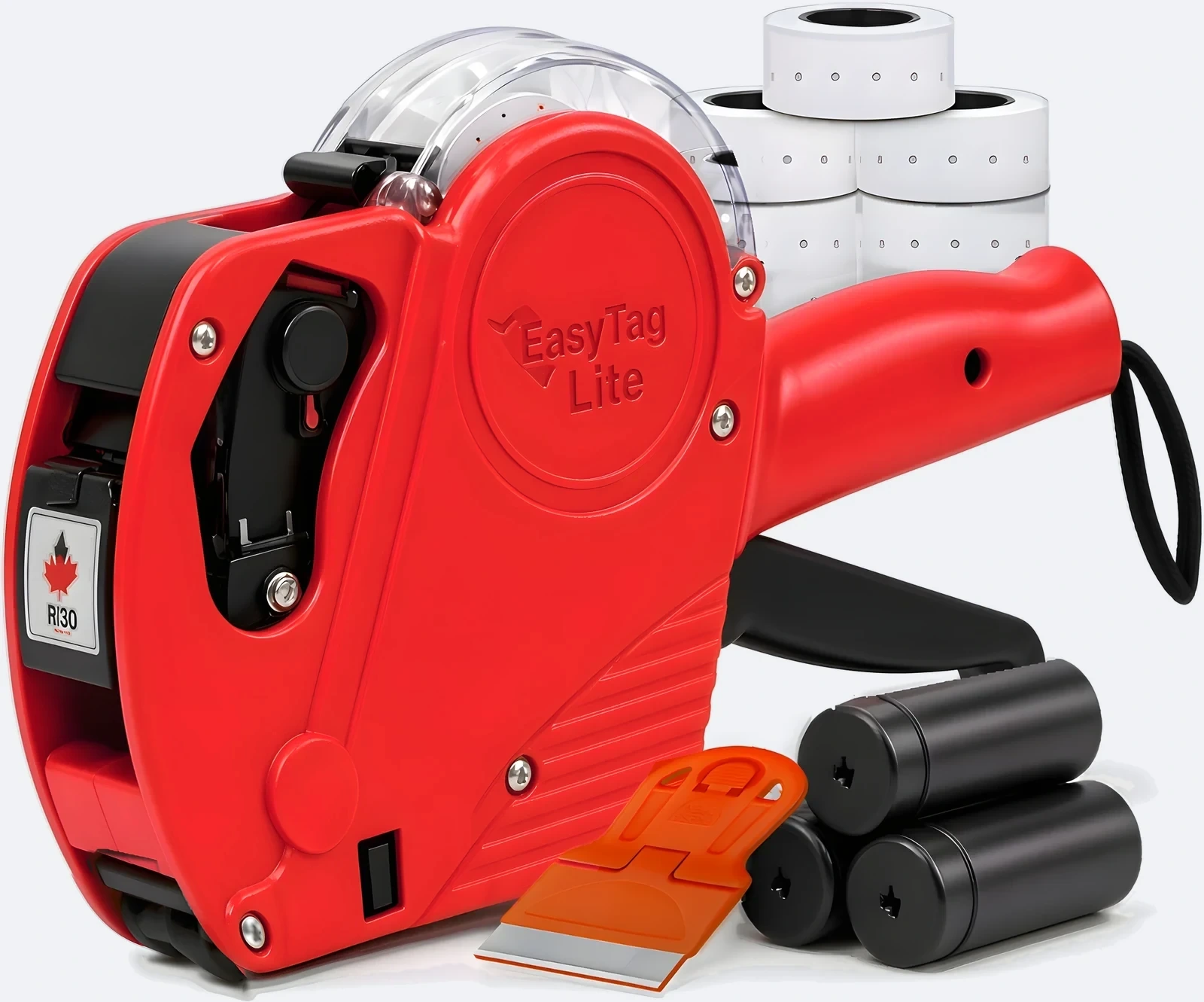
A handheld price gun is built for that kind of day: you set the digits, squeeze, and a printed label goes on in one motion. The gun works by hand, with no batteries and no need for a signal, which matters in a school gym or an outdoor tent.
The Easy Tag MX-5500EOS price gun kit is $19.99, in stock, with 5,000 white labels, three ink rollers and a scraper, and free shipping to the contiguous US. It prints up to eight characters on one line, so you can add a short code beside the price if more than one maker shares a table. The guide to using a price gun covers setting the wheels and loading a roll.
A few things to be careful with:
- Do not put a sticky label on paper sleeves, unprotected prints, or anything a later buyer might want unmarked. Label the bag, a hang tag or the shelf edge instead.
- On clothing, print the price onto a swing ticket rather than the fabric.
- Put the label in the same spot on every item so you can find it at the till.
If you also sell online, keep the market price in the same family as your shop price.
A night-before checklist
- Prices are written down, including bundle prices and the lowest price you will take if someone asks.
- Every item, pack and bundle is labeled.
- You know how many sales pay for the booth.
- Bags, tissue, a pen, spare labels and a little cash for change are packed.
- Signs for the bundles and the price bands are printed and readable from a few feet away.
Keep a simple tally of what sells in each tier. Two markets of notes will tell you what to make more of next weekend.
Frequently asked questions
How do you price items for a craft fair if you also sell online?
Start from the same cost-based price, and make sure the show’s extra costs (booth, travel, packing) are already in that number. Do not cut the stall price below your website just to look busy.
Should I charge more at a holiday market than at a spring fair?
You can, if the offer is actually different: gift wrapping, sets, or items people cannot get from you the rest of the year. A flat “holiday markup†with no change in the product is harder to defend if the same shopper also follows you online.
Do I need a price gun for a small stall?
No, not if you only have a couple of dozen items and you label them neatly the night before. Once you have many pieces at the same price, a price gun is the faster way to make every ticket look consistent.