How to Price Items for a Garage Sale: A Simple Price Guide and a Faster Way to Label
Learning how to price items for a garage sale comes down to one rule. Start at one-quarter to one-third of the new price, then go lower for wear. Money Crashers’ garage sale pricing guide uses that range, and The Non-Consumer Advocate puts the rule of thumb at 10% to 30% of the original price. Round to quarters or whole dollars, leave a little room to haggle, and put a label on every item.
That is the short version. The rest is the detail you need on the morning itself: prices by category, a haggling plan, end-of-day cuts, and a labelling routine that gets a full table done before the first car pulls up.
How to price items for a garage sale: the basic rule
Price used goods at about 10% to 33% of their new price, and let condition decide where in that range each one lands. Clean, working, complete items sit near the top; stained, chipped or incomplete ones sit near the bottom.
The two guides agree on the shape of yard sale pricing and differ on the edges. Money Crashers says to charge “no more than one-quarter to one-third” of the new price. The Non-Consumer Advocate goes as low as 10%. Use the lower end if your street gets bargain hunters and resellers. Use the upper end for items that look close to new.
Two groups break the rule. Money Crashers notes that gadgets still sealed in their box can reach about half of retail, and that antiques can sell for full market value, often $100 or more source: Money Crashers, Jan 2026. For anything you suspect is worth more than a few dollars, check what the same item sold for second-hand before you put a number on it.
Condition is easier to judge when you can show it. Run an extension cord to the table so shoppers can test lamps and small appliances. Keep sets together with a rubber band or a zip bag, and note anything missing on the label. A buyer who sees the flaw priced in has less reason to ask for more off.
Garage sale pricing guide: what to charge by category
Most garage sale items sell for a few dollars or less. Use this garage sale pricing guide as a starting sheet. The ranges come from Money Crashers, updated January 2026.
| Category | Typical garage sale price | Source |
|---|---|---|
| Adult clothing | $3 to $5 each | source: Money Crashers, Jan 2026 |
| Winter coats | $5 to $15 | source: Money Crashers, Jan 2026 |
| Baby clothes | $1 to $3 gently used, 25¢ to 50¢ worn | source: Money Crashers, Jan 2026 |
| Hardcover books | about $1 | source: Money Crashers, Jan 2026 |
| Paperback books | 25¢ to 50¢ | source: Money Crashers, Jan 2026 |
| Toys | $1 to $3 | source: Money Crashers, Jan 2026 |
| Small kitchen tools | $1 to $5 | source: Money Crashers, Jan 2026 |
| Adult shoes | $3 to $10 a pair | source: Money Crashers, Jan 2026 |
| Costume jewelry | 50¢ to $2 | source: Money Crashers, Jan 2026 |
| Sturdy sofa | $150 to $300 | source: Money Crashers, Jan 2026 |
| Coffee table | $50 to $100 | source: Money Crashers, Jan 2026 |
| Dining chair | $25 to $150 | source: Money Crashers, Jan 2026 |
The Non-Consumer Advocate’s list runs a little lower: shirts $1, pants $2, shoes $3, outerwear $5, hardbacks $1 source: The Non-Consumer Advocate, 2019. Neither list is wrong. Good yard sale pricing depends on your neighborhood, the weather and who turns up. Treat both lists as a first draft and adjust after the first hour.
How do you leave room to haggle at a yard sale?
Set each price 15% to 20% above the lowest amount you would accept, the margin Money Crashers recommends. A shopper who asks for a deal gets one, and you still clear your floor.
Decide your floor before the sale, not while someone holds the item out to you. Write it on the back of the label in pencil for anything over a few dollars, so a family member running the table knows how far to go.
Two more habits keep the money flowing:
- Round everything. The Non-Consumer Advocate prices in 25-cent steps to keep the math simple at the cash box.
- Group the small stuff. Money Crashers suggests grouping similar items under one sign. A bin of paperbacks or a box of mugs needs one price card, not forty labels.
Should every item at a yard sale have a price on it?
Yes. Money Crashers’ first labelling tip is to price every item individually with a clear tag. A visible price lets a shopper decide on their own, and it keeps the line moving when you are busy making change.
You have four common ways to do it.
- Pre-printed garage sale stickers from an office supply store.
- Painter’s tape and a marker, which The Non-Consumer Advocate lists as a cheap option.
- Colored dots with a key sign, a reader tip from the same post. One color per price, one sign to explain them.
- A handheld labeller, which prints the price for you. More on that below.
Before you stick anything on books, record sleeves, framed prints or antiques, test one label on a hidden spot. Some adhesives lift paper or leave a mark. For those items, label the bag, a hang tag or the shelf in front of them.
What is the fastest way to label 100 or more items?
A handheld price gun is the fastest way to label a big table. You set the price once on the wheels, and each squeeze prints and sticks a label, so a group of items at the same price takes seconds.
The trick that saves the most time is in our beginner’s guide to using a labelling gun: sort by price first, not by table. Every wheel change costs you about fifteen seconds, so you want as few changes as possible.
A routine for a full driveway:
- Sort into price groups. Lay out boxes or blankets marked 25¢, 50¢, 1, 2, 5 and “ask me”.
- Set the wheels to the first group’s price. Print one test label on scrap paper and check it.
- Label the whole group, then move the box to the table.
- Change the wheels once and start the next group.
- Keep the high-value pieces for last and label them by hand, with your floor price in pencil on the back.
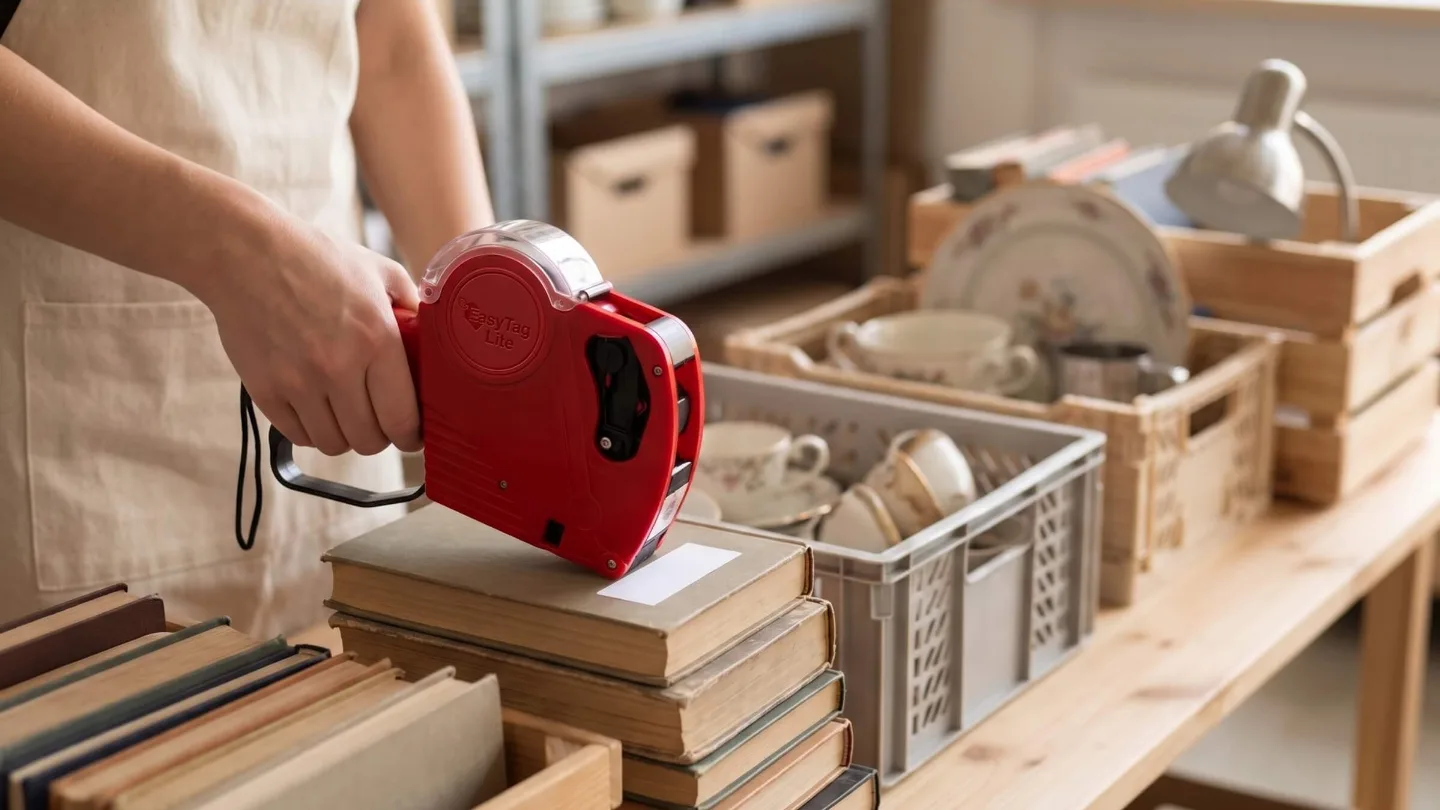
The Easy Tag MX-5500EOS in red prints up to eight characters, so a price fits with room for a code, such as a letter for each family member selling at a shared sale. It is manual, with no batteries to run flat mid-morning. The kit comes with 5,000 white labels, three ink rollers and a cleaning scraper, which you can use after the sale to lift labels off anything that did not sell.
How do you handle end-of-day markdowns?
Cut prices in the last hour or two. Both guides recommend it: The Non-Consumer Advocate puts it as “some money is better than no money,” and Money Crashers suggests lowering prices as the day goes on and setting out a free box.
Make the cut easy to see. A sign that says “everything on this table half off” works for a whole table. For single items, put the new price next to the old one rather than over it. Our post on showing the old price beside the new one explains why shoppers read that as a saving.
Common garage sale pricing mistakes
- Pricing from what you paid. Shoppers compare against other sales, not your receipt. Start from the 10% to 33% range.
- Leaving items unpriced. Some shoppers will not ask, and you cannot answer ten questions at once.
- Pricing on the morning. Label the night before. Early shoppers may turn up before your posted start time.
- Hiding flaws. Price a chipped bowl as chipped and say so on the label. Money Crashers advises honest pricing of flaws, and it saves an awkward return at the cash box.
- No floor price. Without one you will either refuse a fair offer or accept a bad one under pressure.
Frequently asked questions
What percentage of retail should I charge at a garage sale?
Between 10% and 33% of the new price is the usual range. Money Crashers suggests one-quarter to one-third for good items, and The Non-Consumer Advocate goes down to 10% for well-used ones.
How much should I charge for clothes at a yard sale?
Money Crashers lists adult clothing at $3 to $5 each and winter coats at $5 to $15 source: Money Crashers, Jan 2026. The Non-Consumer Advocate prices shirts at $1 and outerwear at $5 source: The Non-Consumer Advocate, 2019.
Should I price items or wait for offers?
Price them. A clear price lets shy shoppers buy without asking. Set each price 15% to 20% above your lowest acceptable amount so you can still say yes to a haggle.
What is the quickest way to put prices on garage sale items?
Sort items into price groups, then label each group in one pass. A handheld labelling gun prints and sticks a label with each squeeze, which beats writing stickers by hand once you pass a few dozen items.
Pricing a big sale this season? The red Easy Tag price gun kit arrives with 5,000 labels and spare ink, ready for the whole table.