1-Line vs 2-Line Price Guns: Which Do You Need?
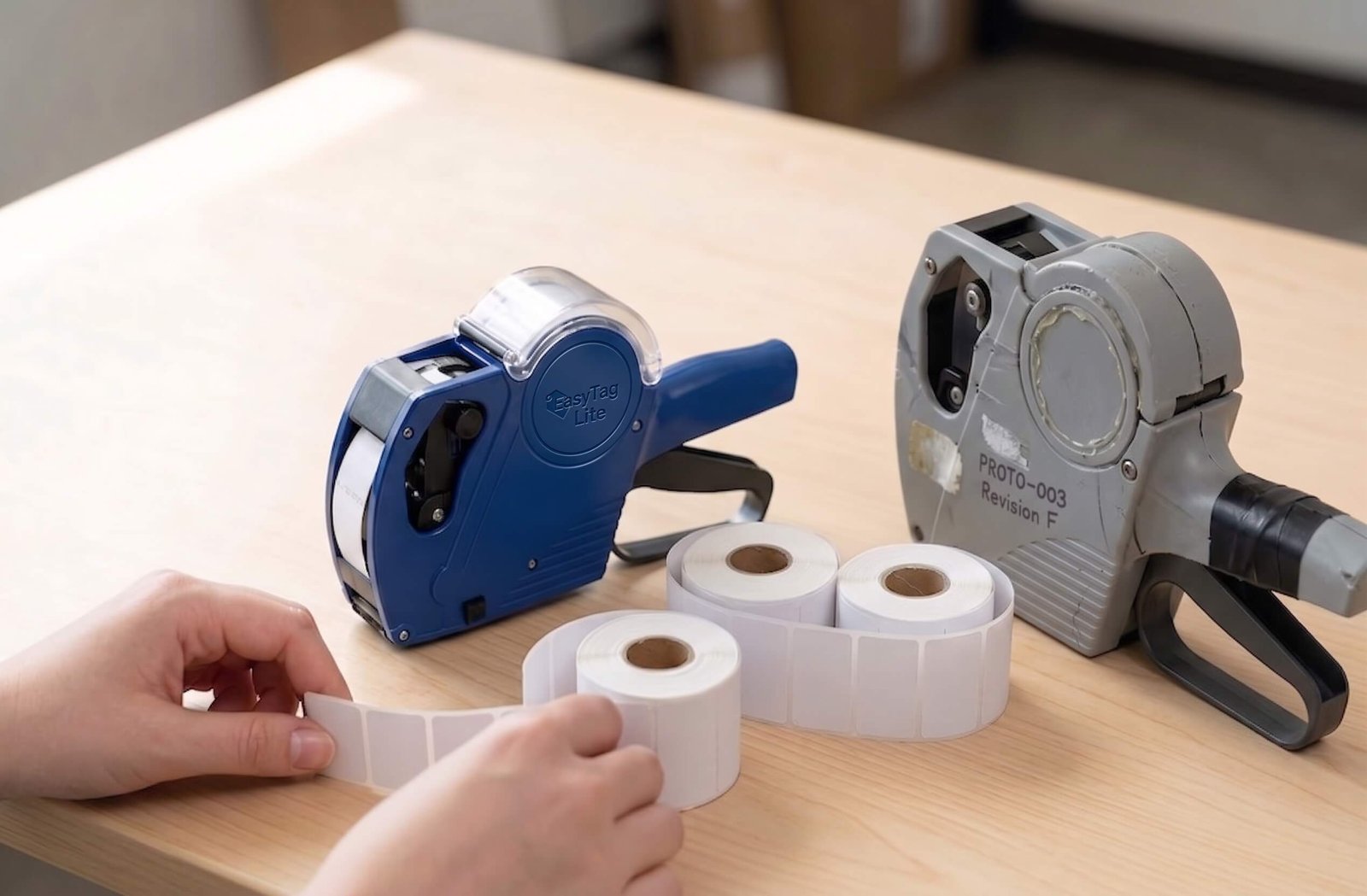
Shopping for a price gun throws one decision at you before any other: one line or two. A 2 line price gun costs more, takes a different label, and prints a second row of characters. Whether that second row is worth anything depends on one question about your stock.
This guide answers it in plain terms. What each type prints, who needs the second line, what the second line costs you in labels, and how to tell in thirty seconds which side you fall on. We sell a one line gun, and we will say plainly when a 2 line price gun is the better buy for you.
What a 2 Line Price Gun Prints
Two banks of print wheels sit inside the gun, stacked. Each bank prints its own row onto a taller label. You set the top row and the bottom row separately, then squeeze once and both rows print together.
The usual 2 line price gun arrangement puts a date, a code or a description on the top row and the price on the bottom. A deli prints a use by date above the price. A stockroom prints an intake code above a location. A shop running a sale prints an old price above a new one.
The second line exists to carry information that changes at a different rate than the price. That is the whole idea behind a 2 line price gun, and it is the only reason to pay more for one.
What a 1 Line Pricing Gun Prints
One bank of wheels, one row of characters, a shorter label. On an 8 digit gun you get eight character positions to fill however you like.
People assume one line means price only. Eight positions hold more than a price. A shop can print a price and a two character season code in the same row, or a received date in the first four positions and a price in the last four. The information fits. It sits beside the price rather than above it.
For most small shops that is enough, which is why a 1 line pricing gun outsells the two line version by a wide margin.
The Label Is the Real Difference
The guns are close mechanically. The labels are not, and this is where a 2 line price gun costs you over the years.
One line guns take the widely stocked MX-5500 compatible size, 21mm x 12mm (0.83in x 0.47in), sold as rolls of 500. Many suppliers make them, they sit on shelves in office supply and packaging stores, and competition holds the price down. A 2 line price gun needs a taller label so two rows of characters fit, and fewer suppliers stock that height.
Before buying any 2 line price gun, search for its refill labels and count how many sellers stock them. A gun with one supplier for labels is a gun with one supplier for your running cost.
Who Needs Two Lines
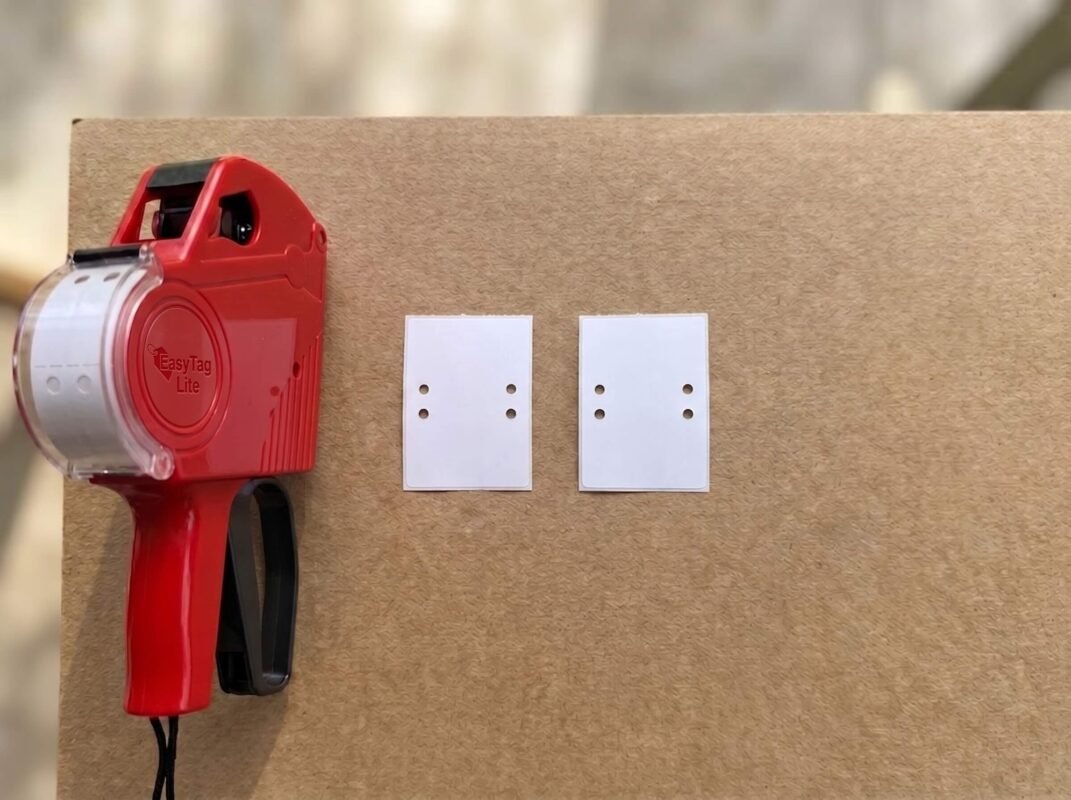
Four situations make the second row worth the money.
- Food retail with date marking. A use by or sell by date has to sit on the item next to the price, and staff need to read it at a glance from a shelf. A 2 line date label gun handles both in one squeeze.
- Bakeries, delis and prepared food counters. Same reason. The date is the compliance item and the price is the sale item, and neither can be missing.
- Was and now pricing on promotions. Some shops print the old price above the new one so the discount is visible on the item itself.
- Warehouses and stockrooms with two codes. A bin location above a part number, or an intake date above a batch code.
If you recognised your business in that list, buy the 2 line price gun. Nothing below changes that.
Who Does Not Need Two Lines
Most small shops fall here, and buying a 2 line price gun for one of these would be money spent on a row you never fill.
- Clothing, gift and homeware shops. The price goes on the swing ticket, the box or the bag. A single row covers it.
- Thrift stores and consignment. Price plus an intake week code fits in eight positions on one row.
- Market stalls and pop ups. Prices change, dates do not exist. One line, and carry spare ink.
- Hobby, collectibles and card shops. Price and a grade or condition code fit on one row.
- Hardware, auto parts and general retail. A price and a short bin code fit on one row.
Buying a 2 line price gun for these shops means paying more for the gun, paying more for every label roll after it, and setting two rows of wheels when one was enough.
The Trade-Offs Nobody Mentions
Listings show you the second row. They rarely show these four.
More wheels to set means more errors
A one line 8 digit gun has eight positions to check before a run. A two line gun has two banks. A wrong character in the top row goes unnoticed for longer because staff read the price and skip the code.
Label supply narrows
Covered above, and it is the biggest one. Ask any shop that bought a 2 line label gun and then discovered the refills came from a single seller at a single price.
The label is bigger
A taller label covers more of a small item. On card packaging, jewellery boxes, cosmetics and small collectibles, the label from a 2 line price label gun can cover artwork you wanted the customer to see.
Two lines take longer to set up
Changing a date every morning means setting the top row every morning. That is fine when the date is the point. It is a daily annoyance when it is not.
You can settle this from a photo before you spend anything. Zoom into the print head on any listing and count the digit wheels, the way you can on the Easy Tag 5500EOS product page. One row of wheels means one line of print, two rows means two, and no product title is as reliable as that count.
A Thirty Second Decision
One question settles the 2 line price gun decision. Does a date or a code need to sit above the price on the same label, and does someone have to read it from a distance?
Yes, buy a 2 line price gun. The second row is doing real work and the extra label cost is the price of doing that work.
No, buy a one line 8 digit gun. Put your code in the spare positions on the same row and spend the difference on labels.
Unsure? Look at what you write on stock by hand today. If you write two separate things at two different times, you want two lines. If you write one number, you want one line.
Where the Easy Tag 5500EOS Stands
Stated plainly: the Easy Tag 5500EOS is a one line, 8 digit price gun. It is not a 2 line price gun and it will not print a date above a price.
If the four situations listed above describe your business, buy a two line gun from a supplier who sells one, and check the refill label supply before you order. That advice costs us the sale and saves you the return.
If you are in the second list, the Easy Tag 5500EOS in Blue ships at $24.99 with 5,000 white labels, 3 ink rollers and a label scraper. Eight alphanumeric wheels on one row, standard MX-5500 compatible labels, and no batteries. The Easy Tag 5500EOS in Red is the same kit in red.
Whichever you buy, the loading sequence is close to identical across both types. Our guide on how to load a price gun covers threading the roll and seating the backing holes on the sprocket teeth, which is the step that causes most first day jams on one line and two line guns alike.
Using Eight Positions Well on One Line
Shops that stay with one line get more out of it by planning the format once.
- Price first, code last. Customers read left to right and stop at the price. Staff know to look at the end.
- Use letters for the code. A two letter season or intake code reads faster than four digits of a date.
- Write the format on a card at the bench. Two staff pricing to two different formats makes a markdown schedule useless.
- Print a test label on scrap first. A wheel one position off is invisible on the gun and obvious on 200 items.
Done well, a one line gun carries most of what shops buy a 2 line price gun to get, at a lower running cost.
Frequently Asked Questions
What is a 2 line price gun?
A price gun with two stacked banks of print wheels that print two rows of characters onto one taller label. Shops use the top row for a date or a code and the bottom row for the price, and one trigger squeeze prints both.
Do I need a 2 line price gun for my shop?
Only if a date or a code must appear above the price on the same label. That mainly means food retail, delis and bakeries, promotional was and now pricing, and stockrooms carrying two codes. Everywhere else, a one line 8 digit gun is enough.
Can a 1 line pricing gun print a date?
Yes, within the same row. An 8 digit gun can print a date in the first positions and a price in the last, or a price with a short code beside it. It cannot stack them on separate rows.
Are 2 line labels more expensive?
A 2 line price gun label is taller and fewer suppliers stock it, so the price per label runs higher and your choice of seller is narrower. One line guns take the widely stocked MX-5500 compatible size, which keeps refills cheap and easy to find.
Can I use one line labels in a two line gun?
No. The label height is part of the gun design, so a 2 line price gun takes only its own taller size. Check what your gun was built for before you order refills.
What is a 2 line date label gun used for?
Marking perishable stock. The top row carries a use by or sell by date and the bottom row carries the price, so staff and customers read both from the shelf without turning the pack over.
Is the Easy Tag 5500EOS a 2 line price gun?
No. It is a one line, 8 digit gun using standard MX-5500 compatible labels. If you need two rows on one label, buy a two line gun instead.
New to the 5500EOS? See loading and using it.
How many characters fit on one line?
Eight on the Easy Tag 5500EOS, one per print wheel, and each wheel carries alphanumeric characters. That covers a price with room left for a short code.
Pick the One That Matches Your Stock
The decision is not about quality. Both types are mechanical guns built on the same principle, and both jam for the same reasons when threaded wrong. The second row is the only difference that reaches your customer.
Need a date above the price? Buy a 2 line price gun and check the label supply first. Need a clear price with room for a code? The Easy Tag 5500EOS in Blue or in Red covers it at $24.99 with 5,000 labels and 3 ink rollers in the box.