Best Price Gun for a Small Retail Store
Most guides to buying a retail pricing gun list ten products and rank them. That helps nobody, because the guns are close cousins mechanically and the differences that matter to you sit in the spec detail, not in the brand on the handle. A gun that suits a deli fails in a thrift store.
This guide runs the other way. Seven criteria first, then a match between store type and gun type, then an honest recommendation at the end with its limits stated. Read the criteria and you can judge any retail pricing gun on any site, including ours.
The short version: for most small shops the right retail pricing gun is one line, eight digits, and built around a widely stocked label size. Buy it as a complete kit with spare ink rather than as a bare gun.
What a Retail Pricing Gun Does
A retail pricing gun prints characters onto a sticky label from a set of rotating wheels, then peels and applies that label as you squeeze the trigger. No power, no software, no account. The mechanism has barely changed in decades because it works.
Two things it does not do. It does not print barcodes, so a retail pricing gun sits alongside a barcode system rather than replacing it. And it does not attach hanging tickets to fabric, which is a separate tool called a barb or tagging gun.
Know that before you shop, and you will avoid the most common return.
The Seven Things That Decide Which Gun You Buy
1. Digit count
The number of print wheels sets how many characters fit on one label. Six digits handles a plain price. Eight digits handles a price plus a date, a season code or a short SKU.
Shops that mark down stock on a schedule want the extra wheels. Being able to read a received date off the label is what turns a guess into a decision on clearance day. If you sell anything seasonal, buy the eight digit retail pricing gun and use the spare wheels.
2. Line count
One line prints a single row of characters. Two lines print two rows on a taller label.
One line covers a price, and a price is what most small shops print. Two lines earn their extra cost in food retail, where a use by date has to sit above the price on the same label, and in stockrooms that print a code above a price. A two line gun costs more, takes a different label size, and gives you nothing if you only print prices. Buy the one line retail pricing gun and put the saving into labels.
3. Label size and standard
Buyers skip this one and regret it. The retail pricing gun is a one time cost. Labels are forever.
MX-5500 compatible rolls are the most widely stocked size for one line guns, which means refills come from many suppliers at competitive prices. A gun built around a proprietary label size hands the supplier control of your running cost. Before you buy any retail pricing gun, search for its refill labels and check that more than one seller stocks them.
4. Ink rollers and running cost
The ink roller is a small ink soaked cylinder that sits above the print head. It dries out with use and with age. Ask two questions: how many spares come in the box, and are replacements a standard part.
A gun sold with one roller and no spares will need an order within weeks of daily use. Guns bundled with spare rollers save you the emergency purchase. No manufacturer publishes a labels-per-roller figure, and roller life shifts with print volume and shelf age, so judge it by eye: change the roller when print turns faint or patchy. The Easy Tag kit ships with 3 ink rollers.
5. Build and trigger feel
Squeeze the body. Heavy flex under hand pressure predicts a cracked shell after a few hundred squeezes. Squeeze the trigger. It should return cleanly with no grinding and no lag.
Pricing a delivery means several hundred squeezes in a session. A stiff trigger is the reason staff abandon a retail pricing gun and go back to writing prices by hand.
6. What is in the box
Compare total cost, not sticker price. A bare gun cannot print until you buy labels and an ink roller, and those two purchases often lift a cheap gun above the price of a complete kit. Write down the real number for each option: gun plus labels plus ink.
7. How it loads
Every one line retail pricing gun loads in roughly the same way, and the step that catches people is the gate over the sprocket wheel. Look for a design where the base plate and the inner gate both open wide enough to see what you are doing. Our walkthrough of how to load a price gun shows the threading sequence, because a gun that seems faulty on day one is usually a gun threaded wrong.
Match the Gun to the Store
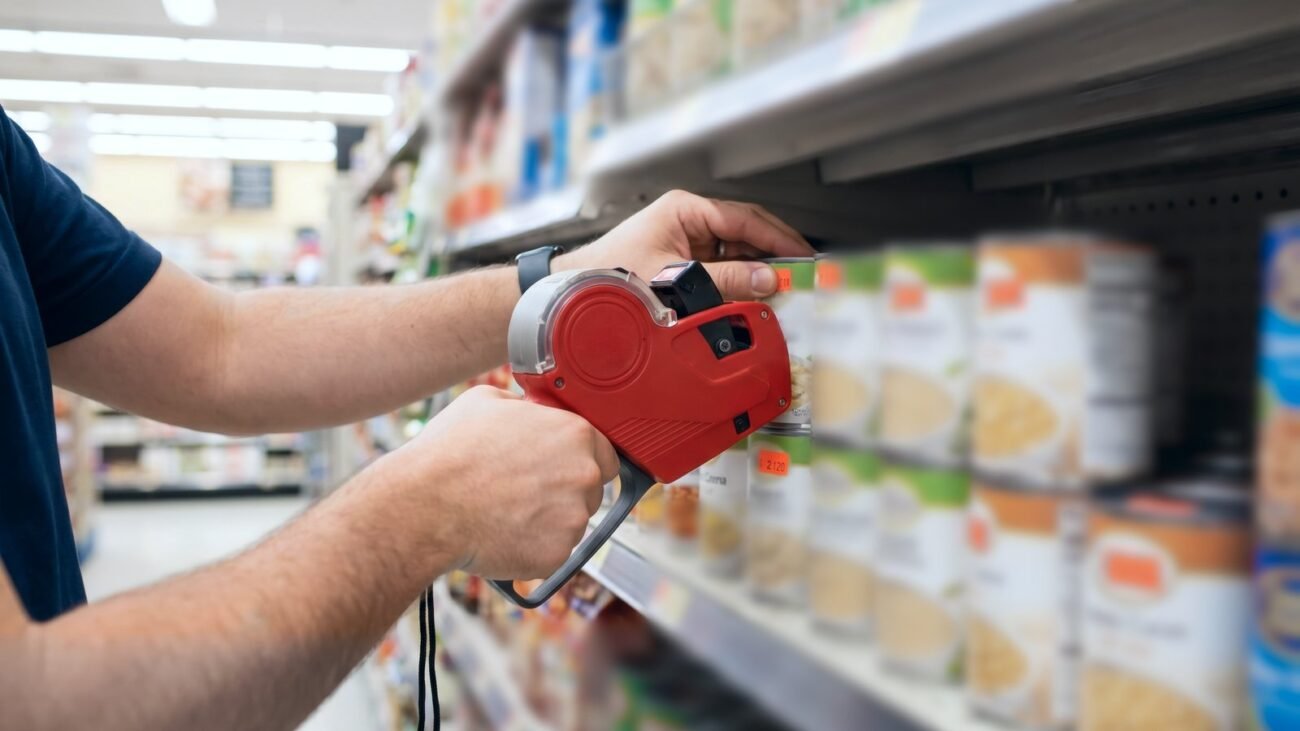
The best pricing gun for your shop depends on what you sell and how often the price changes. Six store types, six different answers to the same retail pricing gun question.
Convenience stores, delis and food retail
Dates matter as much as prices here. A two line gun lets you print a use by date above the price on one label. If your dates live on a separate system and you only print prices at the shelf, a one line retail pricing gun does the job for less money.
Boutiques and clothing shops
A label gun prices boxes, bags, card, hangers and the blank backs of swing tickets. It does not attach tickets to fabric. Most clothing shops run a barb tagging gun for the rail and a one line price gun for everything else.
Thrift stores, charity shops and consignment
High volume, low value, constant repricing. Speed and cheap labels win outright. An eight digit gun lets you code the intake week onto every item, which makes the six week markdown rule enforceable instead of aspirational. A retail pricing gun is often the only piece of equipment these shops buy new.
Market stalls, fairs and pop ups
No power and no signal, so a mechanical retail pricing gun is the only tool that works all day. Buy a complete kit and carry the spare ink rollers with you.
Collectibles, sports cards and hobby retail
Best pricing gun for sports cards is a real and frequent search. Two rules apply: the label must not touch the item, and it must lift cleanly off the sleeve or the toploader. Price the sleeve or a card divider, never the card.
Warehouses, stockrooms and back of house
Retail marking guns get used here for bin codes, intake dates and pick locations rather than prices. Eight alphanumeric wheels handle all three.
What Matters Less Than You Think
Three features get attention in listings and rarely change your day.
- Brand name on the handle. Most one line guns in this class share the MX-5500 body pattern. The label standard and what is in the box separate them, not the badge.
- Colour. Useful for telling two guns apart on a busy counter, which is the only reason it matters.
- Extra symbols on the print wheels. Nice on paper. In practice most shops use the digits and the decimal point.
Spend your attention on labels, ink and trigger feel. Those three decide whether a retail pricing gun is still in daily use next year.
How Much Should a Retail Pricing Gun Cost
Set your budget by what you get, not by the number alone.
- Bare gun, no consumables. Cheapest headline price, highest total cost. You still need labels and ink before it prints.
- Complete kit. Gun, labels and spare ink together. This is where a small shop gets the most for the money.
- Trade and industrial units. Heavier bodies built for all day use in a distribution centre. Overkill for a shop pricing gun on a counter, and priced accordingly.
A small shop pricing a few hundred items a month belongs in the middle bracket. Paying more buys durability you will not use. Paying less buys a second purchase.
The Easy Tag 5500EOS, and Where It Fits
Having laid out the criteria, here is our gun measured against them.
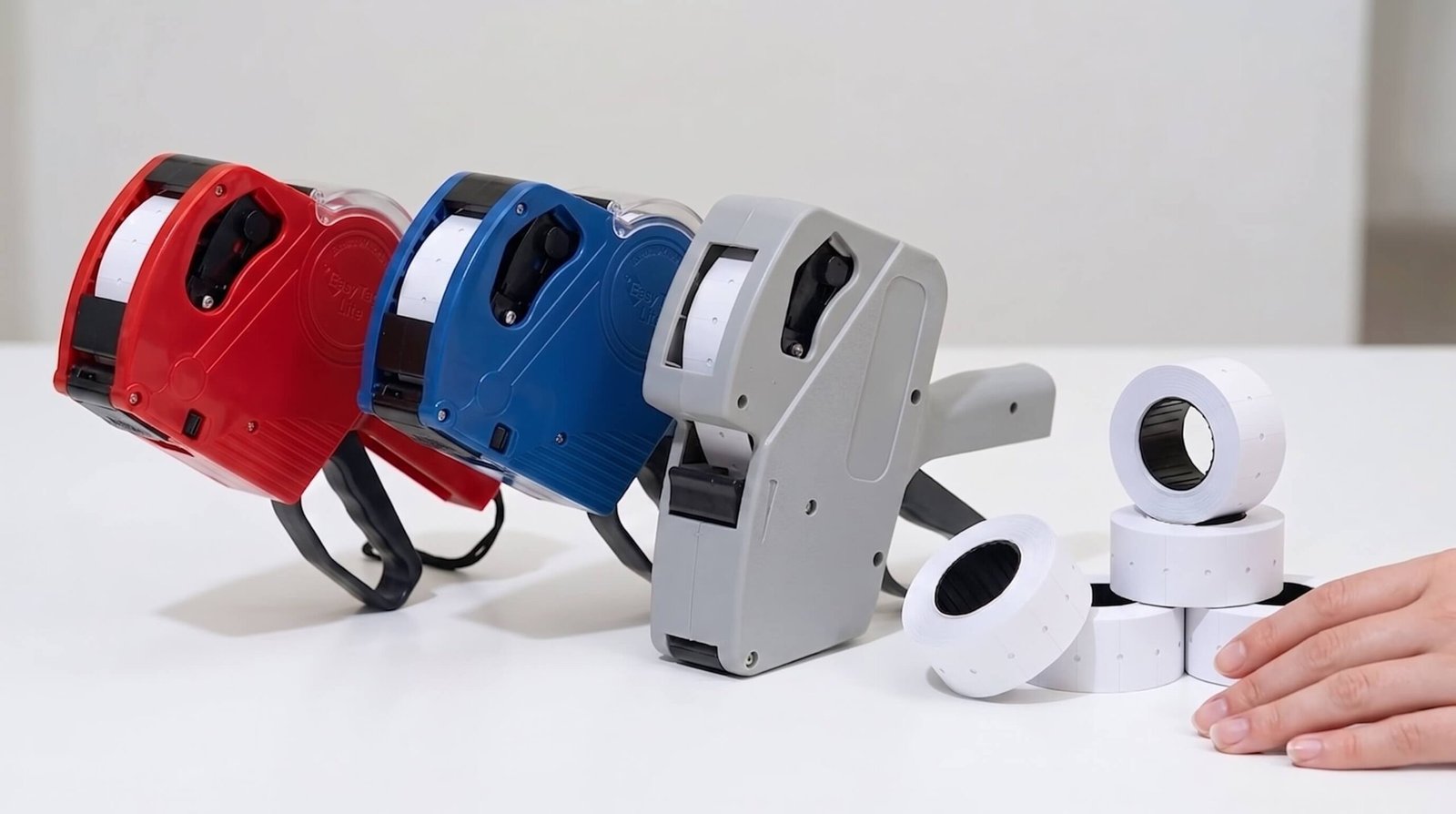
The Easy Tag 5500EOS in Blue is an 8 digit, one line retail pricing gun in an MX-5500 style body, at $24.99. In the box: the gun, 5,000 white labels, 3 ink rollers and a label scraper. The Easy Tag 5500EOS in Red is the same kit in red.
Against the seven criteria:
- Digits: 8 alphanumeric wheels, so a price plus a date or a code fits on one label.
- Lines: one. Enough for prices. Not enough if you need a date above the price.
- Labels: standard MX-5500 compatible rolls at 21mm x 12mm (0.83in x 0.47in), so refills come from many suppliers.
- Ink: 3 rollers in the box.
- Build: reinforced ABS plastic, 0.64 kg (about 1.4 lb), manufacturer part number PG004, mechanical, no batteries.
- In the box: gun, 5,000 labels as 10 rolls of 500, 3 ink rollers, scraper. Nothing else to buy on day one.
- Loading: standard top load cradle with a sprocket gate. Our loading guide covers the sequence.
The honest limits. One line means no date above the price, so a deli that needs both should buy a two line gun. It is a label gun, so it will not attach swing tickets to garments. And it is a small shop tool rather than a distribution centre tool, so a warehouse running it eight hours a day should look at a heavier industrial unit. Returns run 30 days from delivery, unused and in original packaging.
It sits in the middle of the range described above: one line, eight wheels, and a kit that includes labels and spare rollers. Easy Tag lists it in two colours, the 5500EOS in red and the 5500EOS in blue.
A Five Minute Buying Decision
Answer these five and your retail pricing gun choice makes itself.
- Do you print dates on the same label as the price? Yes means two lines. No means one line and you save money.
- Do you code stock by intake date or season? Yes means eight digits.
- Do you tag loose garments on a rail? Yes means you also need a barb tagging gun, which is a different product.
- Can you buy refill labels from more than one supplier? If no, walk away.
- What is the total to get the first label printed? Gun plus labels plus ink. Compare that number across every option.
Frequently Asked Questions
What is the best pricing gun for a small retail store?
For most small shops, a one line, 8 digit retail pricing gun that takes standard MX-5500 compatible labels and ships with spare ink rollers. That combination covers prices, dates and codes, keeps refills cheap, and costs less than a two line gun you would not use.
Do I need a one line or a two line gun?
One line if you print prices. Two lines if a date or a code must sit above the price on the same label, which mainly applies to food retail. A two line gun also takes a different, less common label size.
How many digits should a retail pricing gun have?
Eight, unless your prices are short and you never code stock. Eight wheels let you print a price and a received date, which is what makes a scheduled markdown policy work.
Does a price gun print barcodes?
No. A mechanical price gun prints characters from rotating wheels. Barcodes need a thermal or laser printer. Most small shops run both, using the price gun for shelf and item pricing and a label printer for barcodes.
What is the difference between a price gun and a tag gun for retail?
A price gun prints a price onto a sticky label and applies it. A tag gun for retail usually means a barb gun that pushes a plastic fastener through fabric to attach a swing ticket. Listings use the words loosely, so check the product photos before ordering.
If you are buying your first price gun, here is how to use one.
How long does an ink roller last?
Until the print turns grey and patchy, which depends on how many labels you print and how long the roller has been sitting. Store spares sealed and away from heat, because a spare left loose in a warm drawer dries out and prints faint the day you need it.
Are expensive price guns worth it?
For a distribution centre running a retail pricing gun all day, yes. For a shop pricing a few hundred items a month, the extra spend buys durability you will not reach. Put the money into a complete kit with spare ink instead.
What comes with the Easy Tag 5500EOS?
The 8 digit, one line price gun, 5,000 white labels, 3 ink rollers and a label scraper, for $24.99 in blue or red. It takes standard MX-5500 compatible rolls, so refill labels are widely available.
The Short Recommendation
Buy on labels, ink and what is in the box. Ignore the badge. If you print prices and codes on shelf stock, boxes, bags and tickets, a one line eight digit retail pricing gun is the right tool, and a complete kit beats a bare gun on total cost every time.
The Easy Tag 5500EOS in Blue and the Easy Tag 5500EOS in Red ship at $24.99 with 5,000 labels and 3 ink rollers. If you need two lines or a barb tagging gun, buy those instead. A retail pricing gun that does not match the job is money spent twice.