Date Label Gun: Print Best Before & Use By Dates
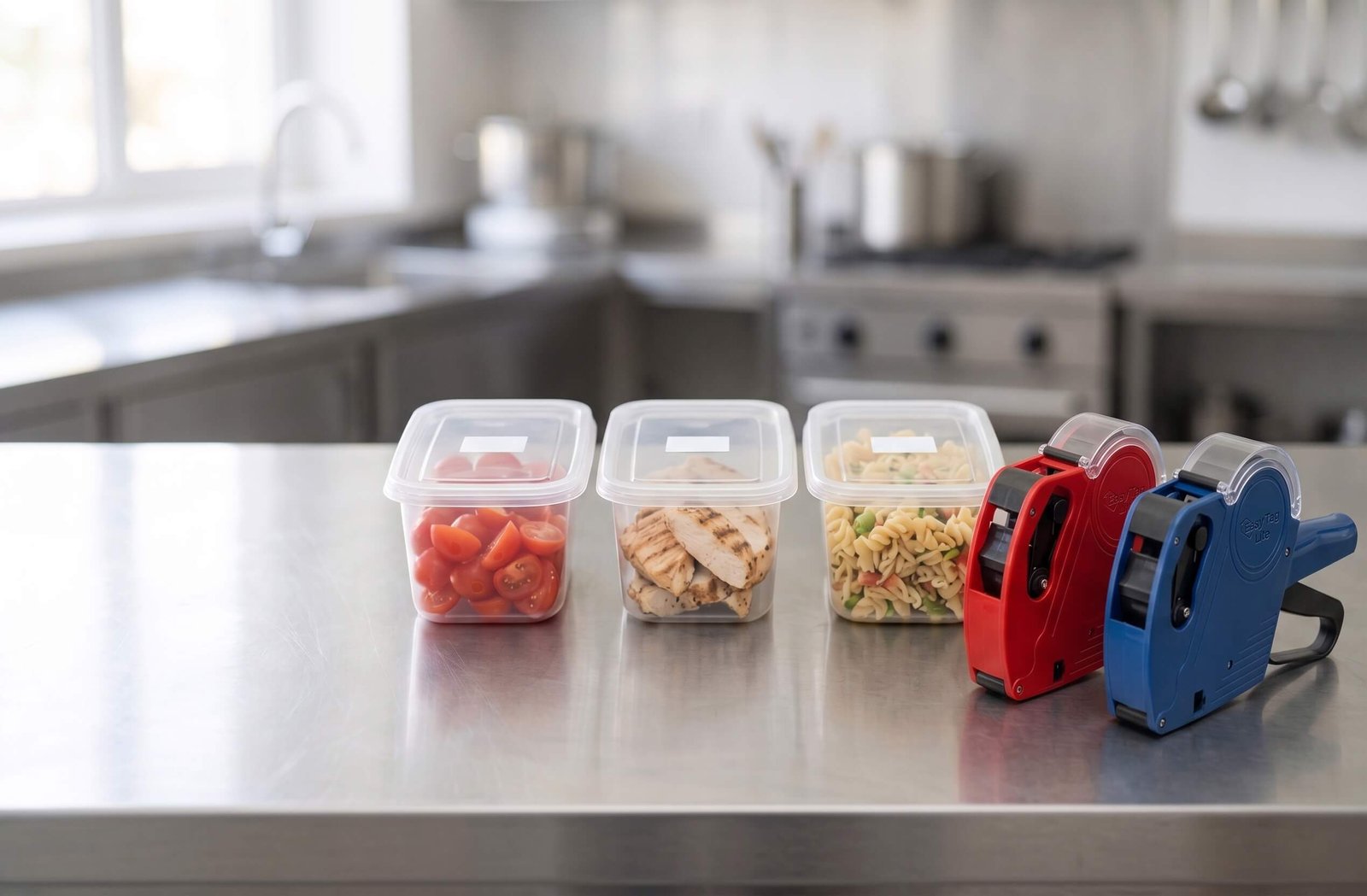
A cafe opens at six, preps twelve trays of food by seven, and by half past seven somebody is writing dates on tubs with a marker pen. The writing smudges in the chiller, three people write the format three different ways, and nobody can read the tub at the back on Thursday. That is the job a date label gun does in about four seconds a tub.
A date label gun is the same tool most people know as a price gun. Eight print wheels on one line, a trigger, a roll of labels. Nothing says those wheels have to hold a price. Set them to a date and you have a date label gun for the cost of a couple of takeaway coffees.
This guide covers how to set dates on an 8-digit gun, which formats fit on one line, who uses one, and how to build a daily routine that survives a busy service. It is written around the Easy Tag 5500EOS, an 8-digit one-line gun on the standard MX-5500 style body.
What a Date Label Gun Actually Is
There is no separate category of tool. A date label gun is a hand-held mechanical labeller with adjustable print wheels, used to print a date instead of a price. Same body, same labels, same ink roller, different characters set on the wheels.
That matters because searching for a date label gun brings up specialist food-industry equipment at specialist prices. For a small kitchen printing a few dozen labels a day, an 8-digit one-line gun does the job at a fraction of the cost, and it doubles as a price gun the moment you need one.
What the gun gives you that a marker pen does not:
- One format, every time. The wheels stay where you set them, so every tub reads the same way.
- Legible in a chiller. Printed characters do not smudge when condensation forms.
- Speed at volume. Press and squeeze. No cap, no writing, no waiting for ink to dry.
- Anyone can do it. A new starter can date fifty tubs correctly on day one, because the format is already set.
Can a Price Gun Work as a Date Label Gun?
Yes, if it has enough print positions. Eight is the number that makes it practical.
Eight wheels give you room for a full date in most common formats, with characters to spare for a separator or a short code. A six-digit gun forces you to drop the separators. A four or five-digit gun cannot carry a usable date at all, which is why cheap short-format guns make poor date guns.
The Easy Tag 5500EOS prints eight characters on one line, so it works as a price gun on Monday and a date label gun on Tuesday. Nothing to convert, nothing to buy. You change the wheels and carry on.
Easy Tag lists the 5500EOS print head as 8 bands of alphanumeric characters, so every position carries letters as well as numbers. Using it as a date label gun therefore opens up the lettered formats below, not only the numeric ones.
Print a full test line onto scrap paper the first time you set the gun up. Thirty seconds tells you exactly what each wheel offers, and you can pick your house format around it.
Count the wheels on your own gun before you buy a second one. A standard eight-wheel body like the Easy Tag 5500EOS in blue prints a full date on one line, which is all most delis and cafes need.
How to Set a Date on Eight Wheels
The mechanism is the same one you would use to set a price.
- Pull the side knob straight out. The wheels will not turn until the knob is out.
- Slide the knob until the marker sits over the wheel you want to change.
- Rotate to bring the character you need into position.
- Move to the next wheel and repeat until the full date is set.
- Push the knob all the way back in. A knob left half out lets the wheels drift, and a drifted date is worse than no date.
- Print one test label onto scrap paper and read it out loud before you touch stock.
That last step is the one to make into a rule. Reading the label out loud catches a wheel set one position off, which is otherwise invisible until forty tubs are wrong.
Date Formats That Fit on One Line
Eight characters is generous but not unlimited. Decide your date label gun format once, write it on a card, and tape the card to the wall above the gun.
Common layouts that fit eight positions:
- DD/MM/YY with separators. Eight characters exactly. The standard in most of the world.
- MM/DD/YY with separators. Eight characters. The standard in the United States.
- DDMMYYYY or MMDDYYYY without separators. Eight characters, and it works even if your wheels carry no punctuation.
- DD MMM YY if your wheels carry letters. Harder to misread than a numeric format, because 03 12 25 is ambiguous and 03 DEC 25 is not.
- Date plus a shift or staff code, for example six characters of date and two for the initials of whoever prepped it. Useful for traceability in a busy kitchen.
Pick one and never mix. A date label gun only removes confusion if the whole team prints the same way. Mixed formats in one chiller are more dangerous than handwriting, because printed text looks authoritative and gets trusted.
Best Before, Use By, Sell By and Packed On
A date on a label is meaningless unless everyone knows which date it is. Four are in common use and they say different things.
- Use by is a safety date. After it, the food should not be eaten, even if it looks and smells fine. It belongs on high-risk chilled items.
- Best before is a quality date. After it, the food is likely safe but may have lost texture, flavour or crunch.
- Sell by is a stock-rotation date for staff, not a customer instruction.
- Packed on or prepped on records when the item was made, and the shelf life is calculated from there.
An eight-wheel date label gun prints the numbers, not the words. Two ways to solve that: pre-printed rolls that already carry the wording with a blank area for the gun, or a colour convention where one label colour means use by and another means prepped on. Whichever you choose, write it on the same card as your format.
Date labelling requirements differ by country, by state and by local health authority, and some food categories carry their own rules. Check what applies to your business with your local authority before you set a house standard. A date label gun prints whatever you set on the wheels, so the format and the wording stay your responsibility.
Who Uses a Date Label Gun
The buyers are almost always small operations doing real volume with small teams.
- Cafes and coffee shops. Prepped sandwiches, cut fruit, opened milk, syrup bottles, sauces decanted from bulk.
- Delis and butchers. Counter trays, sliced meats, marinades, anything portioned in the back and displayed at the front.
- Bakeries. Fillings, creams, proved dough, and finished goods on a short shelf life.
- Meal-prep and food subscription businesses. Every container leaving the kitchen needs a date, and volume makes handwriting unworkable.
- Convenience stores and farm shops. Repacked bulk goods, in-house preparation, short-life chilled lines.
- Bars and restaurants. Opened bottles, house infusions, batched cocktails, prepped garnishes.
- Commercial kitchens and catering. Anything going into a walk-in that a different person will pull out later.
Outside food, the same date label gun handles received dates in a stockroom, batch dates on workshop parts, and expiry dates on consumables in a clinic or salon.
A Daily Routine That Survives a Busy Service
The tool only helps if it has a home and a habit attached to it.
- Set the date once, at the start of the shift. Not per item. Every wheel change costs time and invites errors.
- Print one test label and read it aloud. Ten seconds against forty mislabelled tubs.
- Keep the date label gun in one fixed place, next to the labels, near where prep finishes.
- Label the container before you fill it, while the surface is clean and dry. Wet, cold or greasy surfaces beat every adhesive.
- Press each label down with your thumb for two seconds. A tapped label lifts in the chiller within an hour.
- At close, reset the wheels to tomorrow’s date and shut the ink flap. The gun is ready and the roller stays wet.
One warning worth repeating. Condensation is the enemy of standard label adhesive, so anything going into a chiller or freezer should carry a label made with a cold-temperature adhesive. A date label that falls off in the walk-in is worse than no system at all, because now you have an undated tub that somebody assumes was dated.
Date Label Gun, Printed Labels or Handwriting?
Handwriting costs nothing and works at very low volume. It fails on legibility, consistency and speed the moment more than one person is doing it.
Thermal or inkjet food labels print words as well as numbers, so use by and prepped by appear in full. They cost more up front, need power and consumables, and stop when the printer does.
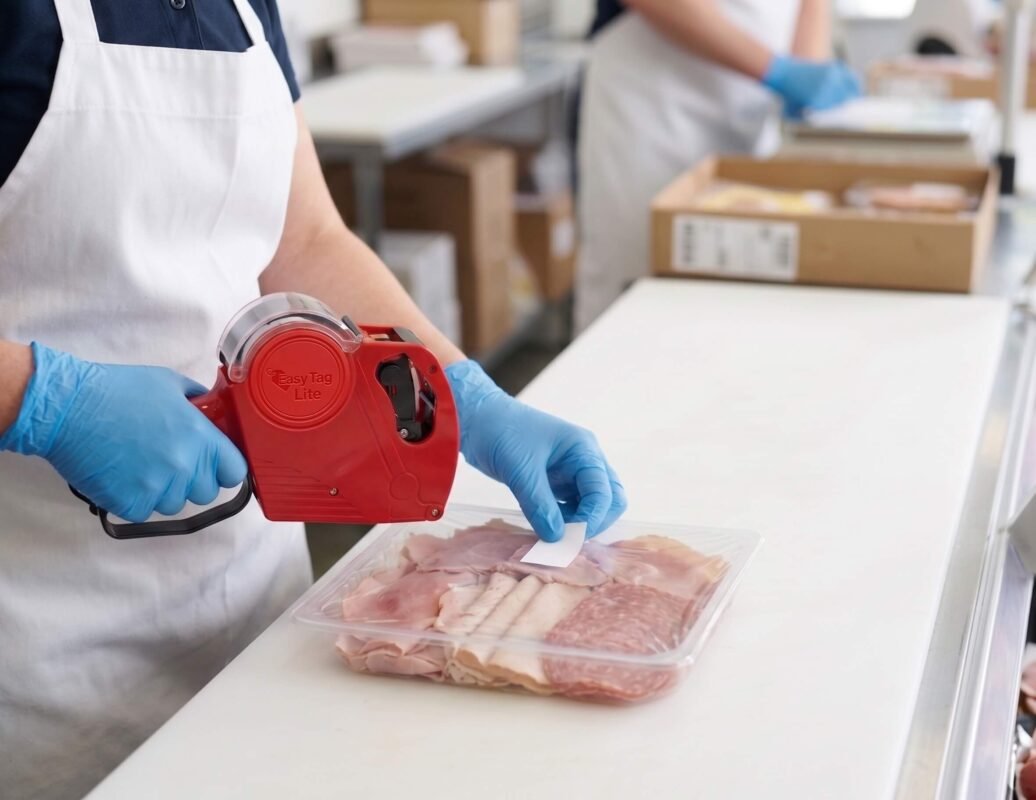
A date label gun sits between them. It is mechanical, so there is nothing to charge and nothing to fail during service. It is fast enough for real volume and cheap enough that a second gun as backup is not a budget decision. It prints numbers rather than words, which is the trade-off you accept for the price and the reliability.
For most small food businesses, the honest answer is that a date label gun handles ninety percent of the job and a pen handles the rest.
Frequently Asked Questions
Can I use a normal price gun as a date label gun?
Yes, if it prints at least eight characters on one line. Eight positions carry a full date with separators. Shorter guns force you to drop characters.
Does a date label gun need batteries?
No. The Easy Tag 5500EOS is fully mechanical. The trigger drives the print head and feeds the label strip, so it works during a power cut and in a walk-in freezer.
Can it print the words "best before" or "use by"?
Not from the wheels, which carry characters rather than phrases. Use pre-printed rolls that already carry the wording, or run a colour convention where each label colour means one date type.
What date format should a small kitchen use?
Whichever is standard in your country, applied identically by everyone. Write the chosen format on a card above the gun. Mixed formats in one chiller are the real risk.
Will the labels stay on in a fridge or freezer?
Standard adhesive struggles once condensation forms. For chilled and frozen stock, buy labels made with a cold-temperature adhesive and press each one down for a full two seconds.
Are the labels and ink safe for direct food contact?
Apply date labels to packaging, wrapping, a lid or the outside of a container, never directly onto unwrapped food. That is the right practice for any hand-held labeller and it keeps the label and the ink away from anything a customer eats.
How many labels will I get through?
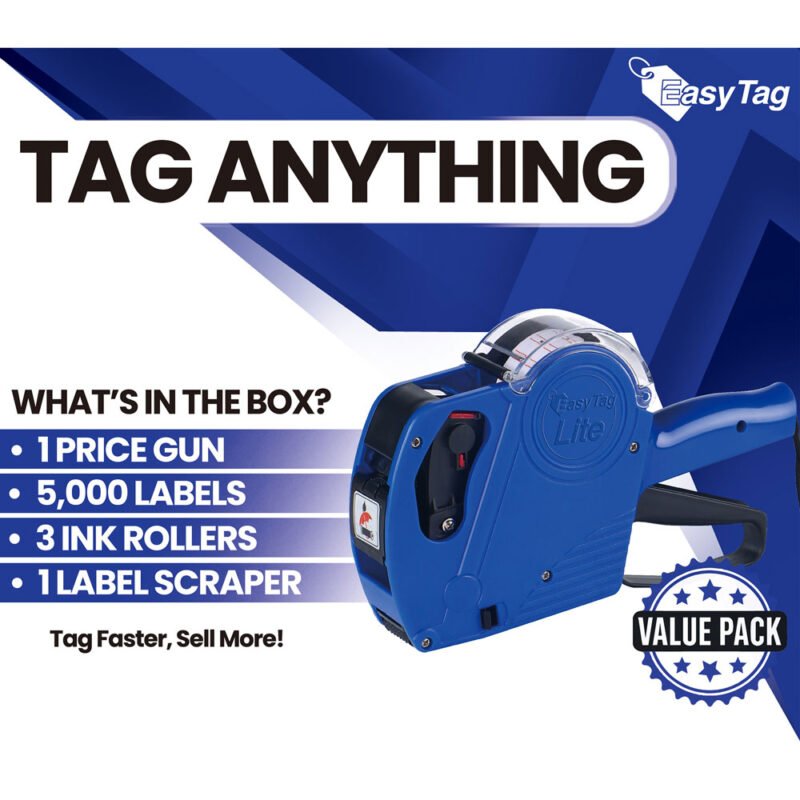
The Easy Tag 5500EOS kit includes 5,000 white labels. A kitchen dating 30 containers a day would take several months to work through that, and the kit also includes 3 ink rollers and a scraper.
Can the same gun still print prices?
Yes. Reset the eight wheels and it is a price gun again. Many small shops date stock in the morning and price it in the afternoon with the one tool.
One Tool, Two Jobs
The reason a date label gun makes sense for a small food business is that it is not a single-purpose purchase. It dates prepped food, it dates deliveries into the stockroom, and it prices stock on the shop floor, all from the same eight wheels.
The Easy Tag 5500EOS is an 8-digit, one-line gun on the standard MX-5500 style body. It ships as a complete kit at $24.99 with 5,000 white labels, 3 ink rollers and a label scraper, so it is working the day it arrives. Choose your colour: the Easy Tag 5500EOS in Blue or the Easy Tag 5500EOS in Red.
US standard delivery runs 3 to 5 business days, and returns are accepted within 30 days of delivery on unused kits in original packaging. Easy Tag does not ship to Alaska, Hawaii, Puerto Rico or US territories.
Never used one before? Start with How to Load a Price Gun: A Beginner’s Step-by-Step Guide, then set your date and go.