Acrylic Sign Holder Ideas: 12 Ways to Display Promotions
A sheet of paper taped to a wall, curling at three corners, advertising an offer that ended in June. Every shop has one. It is telling customers more about the business than the offer ever did.
An acrylic sign holder solves a small problem completely: it gives a printed sheet somewhere permanent to live, so the message can change weekly while the fixture stays put. Below are twelve acrylic sign holder ideas grouped by where they go in a shop, plus the design rules that decide whether anyone reads them.
What an 8.5 x 11 acrylic sign holder actually is
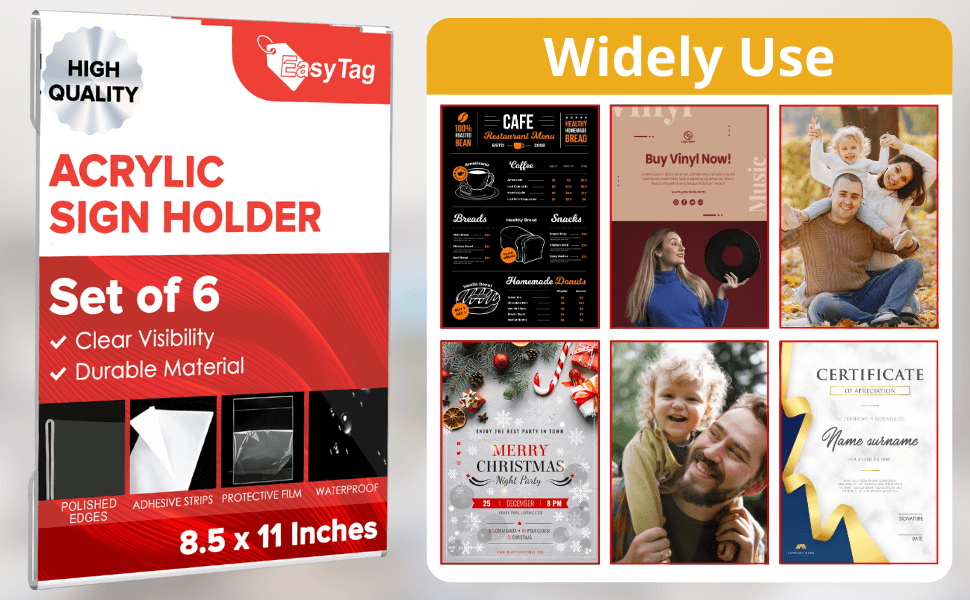
A clear acrylic frame sized for a standard US letter sheet, 8.5 inches wide by 11 inches tall, in portrait orientation. It loads from the top, so the paper slides in and out without unmounting anything. The Easy Tag version mounts to a wall with pre-applied heavy-duty adhesive strips, which means no drill, no anchors and no holes in a rented unit.
Acrylic rather than glass matters in a shop. It takes a knock from a trolley without shattering, and it resists scratching and dust in a way paper on a wall does not.
The practical consequence runs through every idea below: you change the sheet, not the fixture. A new offer costs one sheet of paper and twenty seconds.
Acrylic sign holder ideas for the counter
1. The single add-on offer
The last four feet before the till is the highest-intent space in the shop. The buying decision is already made, so an add-on competes with nothing. One holder, one offer, one price. Batteries, care kits, gift bags, a second item at a reduced price.
Rotate it weekly. A counter sign that never changes stops being read by your regulars within a fortnight.
2. The bundle maths
Bundles fail when the shopper has to do arithmetic. Print the sum and let the sign do it: “Gun $24.99 + spare rolls $X = $Y together”. Put the holder beside the bundled stock so the numbers and the products are in the same glance.
3. Terms, hours and policy
Returns policy, opening hours, card minimums, holiday closures. These questions arrive at the counter over and over, and each one costs a member of staff thirty seconds. A holder answers them before they are asked, and looks deliberate rather than apologetic.
Acrylic sign holder ideas for the entrance and window
4. The week’s headline offer
The first eight feet inside the door is where a shopper decides what kind of shop this is. One sign, one message, one end date. “20% off all winter stock, ends Sunday” frames the whole visit before browsing starts.
5. The window notice that stays legible
Paper taped inside a window fades, curls and yellows within weeks of direct sun. Behind acrylic it stays flat and readable, and swapping it is a two-second job rather than a scraping job.
6. Wayfinding for a bigger floor
Wall-mounted holders carrying “Clearance, rear of store” or “Fitting rooms upstairs” keep customers moving. A shopper who cannot find a section leaves without asking, and you never learn it happened.
Acrylic sign holder ideas for shelves and rails
7. The reason-to-buy card
Beside a premium or unusual product, a short card explaining what makes it different. Handmade, locally sourced, staff pick, fits X. Shoppers buy the expensive option more readily when someone has told them why it costs more.
8. Size charts and compatibility notes
Clothing sizes, fitting charts, what works with what. These are the questions that stop a purchase mid-decision, and a chart on the rail answers them without a staff conversation.
9. The end-of-rail markdown sign
Put the discount maths in one holder at the end of a clearance rail instead of repeating it on every hanger. Cleaner to look at, and a five-second job when the discount changes.
Acrylic sign holder ideas for cafes, delis and bakeries
10. Daily specials and the allergen list
Specials change daily, which is the whole reason a permanent fixture with a swappable sheet beats a printed board. Allergen information belongs in the same place, where a customer can read it without asking staff in front of a queue.
For dating the stock behind the counter, a date label gun handles the containers while the sign holder handles the customer-facing information.
11. Provenance and “made today”
Where the bread was baked, which farm the eggs came from, what went into the soup. Food buyers pay more for information, and it costs one printed sheet.
Acrylic sign holder ideas for the back of house
12. The rules on the stockroom wall
The least glamorous use and one of the most valuable. Put the labeling rule, the opening checklist and the delivery routine behind acrylic in the stockroom. Paper pinned to a board gets torn, goes missing and ends up ignored. A framed sheet reads as a standard, and new staff train themselves from it.
How to design a sign people actually read
The holder is the easy part. Most signs fail on the sheet inside them:
- One message per holder. A sign carrying three offers gets read as wallpaper.
- Headline readable from six feet. If you have to walk up to it, it is not a sign, it is a document.
- Dark text on a light background. Reverse type looks smart at a desk and disappears under shop lighting.
- Put the number in the headline. “Save $7” beats “Special offer inside”.
- Always date the offer. “Ends Sunday” converts better than an open-ended deal and saves you an argument three weeks later.
- Leave white space. A sheet filled to the edges reads as a form. Half-empty reads as a sign.
- Print, do not handwrite. Handwriting on a counter sign undoes the professionalism the holder was bought for.
Where to mount them
Adhesive strips hold on smooth, clean, dry surfaces. Painted plaster, tile, laminate, glass and metal all work. Clean the spot with rubbing alcohol first and let it dry, because dust under an adhesive strip is the reason most of them fall off.
Textured brick, rough render and freshly painted walls are the three surfaces to avoid. Fresh paint takes weeks to cure and will lift with the strip.
Mount at eye height for adults, roughly 55 to 65 inches from the floor for anything a customer reads while standing. Counter signs sit lower and get read from above, so tilt is less of a problem than distance.
How many a shop needs
A small shop running the essentials needs four: one at the counter, one at the entrance, one for the policy notice and one in the stockroom. That covers every high-value position on this list.
Anything with multiple rails, sections or a food counter climbs quickly, which is why they sell in packs. Easy Tag lists pack sizes from 1 to 24, with the range priced from $7.99 to $55.99, so a full fit-out of a small floor stays inside a modest budget.
Buy one or two more than you think you need. The spare gets used within a month, and the one thing worse than an empty wall is a taped-up sheet next to a framed one.
Mistakes that undo the work
- Leaving an expired offer up. A March sale still showing in August teaches shoppers to ignore all your signage.
- Too many holders. Six signs in one sightline cancel each other out. Sightline discipline beats sign count.
- Mounting on textured or fresh paint. The strip lifts, the holder falls, and you have a scuff on the wall.
- Mixing framed and taped signs. One taped sheet beside three framed ones makes the whole wall look improvised.
- Handwritten inserts. The acrylic says professional, the biro says otherwise.
The Easy Tag acrylic sign holder
Clear acrylic, 8.5 x 11 inches, portrait, top-loading, wall mount with heavy-duty adhesive strips already applied. No drilling and no anchors, so it works in a rented unit. It fits standard US letter paper with no trimming, and it is shatter-resistant and scratch-resistant for a working shop floor.
Available in packs from 1 to 24, priced from $7.99 to $55.99, on the Easy Tag product page and on Amazon. Shipping is free on shopeasytag.com, and returns run 30 days on unused items in original packaging.
Sign holders handle everything longer than a price. For the prices themselves, a price gun prints eight characters onto a 22 x 12 mm label in about a second. The beginner’s guide to using a price gun covers the routine, and the complete guide to retail tag guns explains which tool suits which kind of stock.
Frequently asked questions
What size acrylic sign holder do most shops use?
8.5 x 11 inches, because it takes a standard US letter sheet with no trimming. You print from any office printer and slide the sheet straight in.
Do adhesive wall mount holders damage paint?
On cured paint they hold well and come off cleanly with steady pressure and a little warmth. Fresh paint is the risk, because it takes weeks to cure fully and can lift with the strip. Wait a month after painting before mounting anything.
Can I use them in a rented unit?
That is the main reason to choose adhesive over screws. No drill, no anchors, no holes to make good when the lease ends.
Which acrylic sign holder ideas work best in a small shop?
Start with the counter offer and the entrance headline. Those two positions carry the highest intent in any shop. Add the policy notice and the stockroom rules once the first two are running.
Landscape or portrait?
The Easy Tag holder is portrait, matching how letter paper prints by default. Portrait also suits a headline stacked above supporting lines, which is how most shop signs read.
How often should I change the sheet?
Counter and entrance signs weekly. Policy notices and stockroom sheets stay until something changes. A sign that never changes stops being read.
Can they hold menus in a cafe?
Yes, and daily specials and allergen notices, which is one of the more common acrylic sign holder ideas in food service. Reprint the sheet each morning and swap it in seconds.
How many should I buy to start?
Four covers a small shop: counter, entrance, policy notice, stockroom. Buy one spare, because you will find a use for it within a month.
Pick two and start
All twelve acrylic sign holder ideas above are worth running, but none of them work as well as the first two done properly. Put one holder on the counter and one inside the door, print a real offer with a real end date, and change the sheet every week. Everything else on this list is an extension of that habit.
Questions on pack sizes or mounting: call 480-688-6950 or email hello@shopeasytag.com.